
With imports up 233% between January and May and 542 Taiwanese companies building AI hardware in Guadalajara, Ciudad Juárez and Tijuana, the logistics flow between the two countries creates infrastructure challenges for Mexico
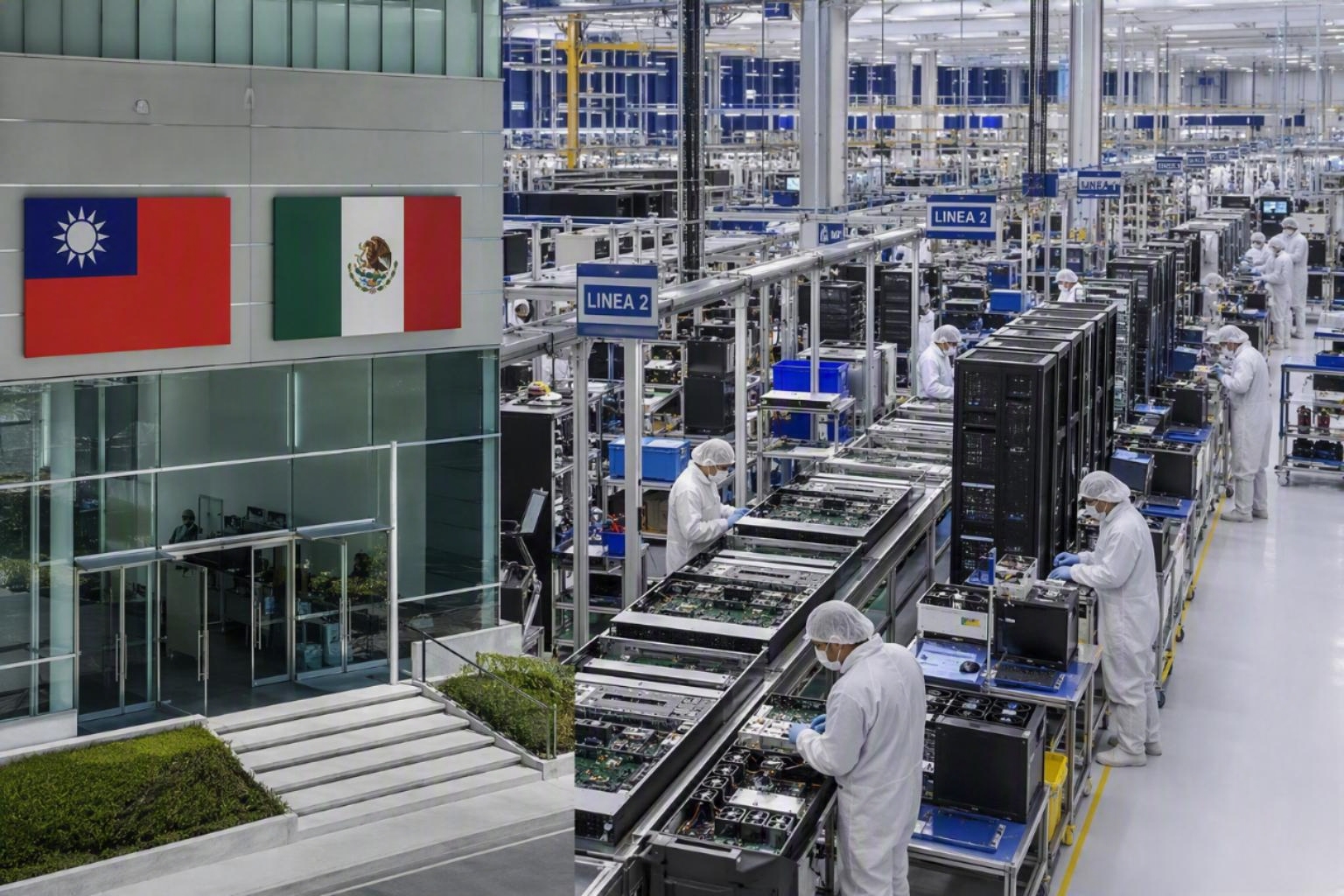
The article published this morning in El Cronista México confirms what Banxico data had been signaling month after month: Taiwan is no longer a secondary supplier to Mexico but the third most important origin of its imports, already ahead of the European Union. Mexico is seeing an extraordinary acceleration in computer equipment exports, driven by strong U.S. demand for data centers and artificial intelligence, and Taiwan —the world's leading semiconductor producer, ahead of China— is the player bringing the assembly of that equipment to a location closer to the end market. By the end of May 2026, in just five months Taiwan sold Mexico as much as Mexico imported from it in 2024 and 2023 combined, with more than 542 Taiwanese-owned companies operating in the country and building hardware for the AI data centers under construction in the United States. The companies driving this flow are well-known names in the global tech sector: Foxconn, Quanta Computer, Pegatron, Wiwynn, Ingrasys and PCE Technology, located mainly in Guadalajara, Ciudad Juárez and Tijuana.
The logic behind this phenomenon is straightforward and rooted in the Trump administration's trade policy. When Washington escalated tariffs on Chinese products, companies manufacturing in China needed to relocate production to countries with preferential access to the U.S. market; Mexico, with the T-MEC (USMCA) in force, was the most obvious answer, and Taiwan —with decades of experience in precision manufacturing, electronics and semiconductors— found in Mexico the strategic destination it needed to keep serving the North American market without the tariff cost China now faces. Between January and March 2026, companies imported more than 19,266 million dollars in products from Taiwan to manufacture semiconductors and data center hardware, compared with only 5,028 million dollars in the same period of 2025, a nearly fourfold increase in a single year with no precedent in the two countries' trade history.
For Mexican logistics, the scale and speed of this phenomenon pose infrastructure challenges the sector has not yet fully solved. Data centers and semiconductor plants require large amounts of electricity and stable cooling systems, and several Mexican regions already face power grid constraints; access to water will also be critical, since some industrial processes use considerable amounts of ultrapure water; and customs and logistics infrastructure will need to improve to absorb the growth in these flows with the agility tech supply chains demand. For freight forwarders and customs brokers managing imports from Asia, Taiwan's growth as an origin has concrete implications for tariff classification —semiconductors, circuit boards, servers and electronic components have specific tariff codes and require detailed technical documentation— and for origin management under the T-MEC, especially when Taiwanese components are incorporated into products bound for export to the United States. The rule of origin is not an administrative detail in this context: it is the line between a shipment with preferential tariff access and one without it.
SOURCES: El Cronista México · Forbes México · Expansión · El Financiero · Banamex / Citigroup · Industrial News Baja California · Banxico
Published: August 14, 2026
Last updated: November 27, 2026
Slug: taiwan-has-become-mexicos-third-largest-supplier-and-is-redrawing-the-logistics-of-the-national-technology-corridor